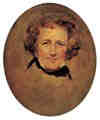
Dr Thomas(Tom) Wakley MP [249]
- Born: 11 Jul 1795, Land Farm, Membury, Devon.
- Christened: 1795
- Marriage (1): Elizabeth Goodchild(Maybe Goldsmith) [253] in 1820 in St James Church, Piccadily
- Died: 16 May 1862, Madeira aged 66
- Buried: Catacombs, Kensal Green Anglican Church, London.

 General Notes: General Notes:
Was very instrumental in getting legislation passed for the registration of doctors.
He founded "The Lancet" a medical journal.
Editor of the Lancet from 1823 to 1862.Followed in this capacity by 2 of his 3 sons who ran the journal for 85 years.
Supported the cause of the Tolpuddle Martyrs in Parliament.
Helped to found Epsom College.
There is a blue plaque on his house in Bedford Square,London.
MP for Finsbury constituency.
Further Information can be found at Wikipedia Ref
Wakley, Thomas (1795-1862), medical journalist , Doctor and Coroner and politician, was born on 11 July 1795 at Land Farm, Membury, Devon, the youngest son in the family of eleven children of Henry Wakley (1750-1842), a prosperous farmer, and his wife, Mary, née Minifie. He went to good grammar schools at Chard and Honiton (*went to sea as a cabin Boy for a year at age 11) ….
…"Personal life
Despite his personal historical visibility and the continuing importance of the journal he founded, Wakley remains enigmatic. He was ever indignant at social or political injustice, and he never lost his concern for the plight of the ordinary individual. He hated cant and humbug, which endeared him to Charles Dickens. At the same time he was personally ambitious, with a highly developed sense of his own worth. He maintained a home in Bedford Street, London, which was burn down and an estate, Harefield Park, and entertained lavishly, even while remaining abstemious himself. He seemed addicted to the rough and tumble of turbulent public life, but he remained a devoted family man. A lifelong radical, he was also an active Anglican. His wife's ( daughter of Goodchild-Governor at St Thomas's ) death in 1857 affected him deeply. A daughter died young, but he was intensely proud and supportive of his three sons. Two of these, Thomas Henry Wakley (1821-1907) and James Goodchild Wakley (1827-1886), followed him into medical journalism, continuing The Lancet as a family business until the twentieth century. The middle son, Henry Membury, became a barrister and deputized for his father as a coroner.
Wakley was a large man with enormous energy, who routinely worked sixteen-hour days. In his early life he acquired fame as an accomplished boxer. In 1851, following a strenuous day involving seven inquests and attendance at the House of Commons until midnight, he was found unconscious outside the Lancet office, where he had gone to continue working. This episode convinced Wakley to slow down, and although he left parliament, he retained the coronership and The Lancet, which his sons joined him in editing. Their take-over was probably gradual, and Wakley retained the official editorship until his death.
In the late 1850s Wakley enjoyed a brief period of better health, and he contemplated running again for parliament. However, in late 1860, signs of active pulmonary tuberculosis supervened. He spent the winter of 1861-2 in Madeira, where his lungs began to heal. He had made arrangements to return to England, but on 11 May 1862 he slipped on the beach, the haemoptysis recurred, and he died on 16 May. His embalmed body was brought back for burial beside his wife and daughter in Kensal Green cemetery on 14 June.
W. F. BYNUM (Oxford University Press)
PRESS RELEASE MARCH 2015 - CHARD SCHOOL, SOMERSET
Head of Chard School - Paul Cawley-Wakefield 01460 63234
Chairman Old Cerdics Association - Graham Chamberlain 07967 860780
OLD BOYS TO HONOUR FAMOUS SON
To mark the 85th anniversary of the Old Cerdics Association former pupils of Chard School will be presenting the school with a framed portrait of one of their most famous sons THOMAS WAKLEY (1795-1862), one of the most influential social and medical reformers of the 19th century :-
FOUNDER EDITOR 'THE LANCET' MEDICAL JOURNAL 1823
MEMBER OF PARLIAMENT 1835-1852
CORONER FOR WEST MIDDLESEX 1839-1862
The presentation will take place at Chard School at 10.00am on Monday 23rd March and the portrait will be unveiled by The Rt.Hon.David Laws MP, Minister for Schools,before the whole school community and the Deputy Editor of 'The Lancet' Dr.Astrid James.The Mayor of Chard, Councillor Mrs Jenny Kenton and surviving members of the Wakley family will also be present.
******************************************************
THOMAS WAKLEYwas a truly remarkable man for which there is little public recognition apart from a bust in the offices of 'The Lancet'. Born in Membury, Devon in 1795 he attended Chard School in Somerset. After school he trained as a pharmacist in Taunton and 'walked' to London where he qualified as a surgeon.It was not long before his conflicts with the medical establishment began that led to the founding of 'The Lancet'.
THE LANCET - 'The Lancet', named appropriately after a surgical instrument and a window to illuminate,aimed to tackle corruption in medicine. Among its many campaigns was the exposition of mishaps at London teaching hospitals; the proper supply of bodies for dissection; the establishment of a register for medical practitioners; raising the standard of coroner's inquests; tackling the adulteration of food; fraudulent medical practices and serious failings of the Poor Law.From a few copies in 1823 'The Lancet' is now acknowledged as the leading authoritative medical journal with a global reach world-wide delivering latest medical news and clinical research. It has editorial offices in London, New York and Beijing.
MEMBER OF PARLIAMENT- Thomas Wakley became a radical Member of Parliament for Finsbury with no particular political allegiance, a seat he was to hold for nearly 20 years. He was a conscientious attender making over 900 contributions to debates in the House of Commons. Wakley's political interests extended far beyond the medical, he favoured free trade, supported the repeal of the Irish Act of Union and the abolition of slavery.
Further input from Charles Gillett,Melbourne.
Thomas Wakley (11 July 1795 - 16 May 1862) was an English surgeon. He became a demagogue and social reformer who campaigned against incompetence, privilege and nepotism. He was the founding editor and owner of The Lancet ; Coroner for West Middlesex and radical Member of Parliament (MP) .
…………………………..
Thomas Wakely, the youngest of Henry Wakley's eleven children, was born in Membury, Devon, on 11th July, 1795. Henry Wakley was a country squire who bred racehorses. After being educated at the local grammar school, he left at the age of sixteen, to be apprenticed as an apothecary in Taunton. Thomas enjoyed the work and decided to become a surgeon. After training at Guy's Hospital, London, Wakley qualified in 1817.
Wakley established himself as a doctor in Argyll Street, one of the most expensive areas in London and in February 1820 married the daughter of a wealthy iron merchant. Six months later the Wakley's house was destroyed by fire. Wakley's claim for insurance was refused as the fire had been started deliberately. Thomas Wakley claimed that the fire had been an attempt to murder him. While waiting for the insurance company to pay him for his losses, Wakley became a doctor in a less prosperous part of London.
In 1821 Wakley met the radical journalist William Cobbett, who published the weekly newspaper Political Register. Wakley told Cobbett about how the need to reform in the medical profession. Cobbett suggested that Wakley should publish a journal that could be used to campaign for these reforms.
Wakley liked the idea and in October 1823 began publishing The Lancet. In the journal Wakley criticised the autocratic powers of the council that ran the Royal College of Surgeons. He also campaigned for a united profession of apothecaries, physicians and surgeons and a new system of medical qualifications to help improve standards in the medical profession.
In 1828 Thomas Wakley became involved in the campaign for parliamentary reform. This brought Wakley into contact with other political reformers in London and in 1832 he was asked to become the Radical candidate for Finsbury. With 330.000 potential voters, this new constituency was one of the largest in Britain. With the support of his two closest political friends, Joseph Hume and William Cobbett, Wakley campaigned for an extension of the vote, the removal of property qualifications for parliamentary candidates, the repeal of the Corn Laws, the abolition of slavery and the suspension of the Newspaper Stamp Act. Wakley was defeated in 1832 but he won when he tried again in January 1835.
Thomas Wakley spent the next seventeen years in the House of Commons. Thomas Wakley's maiden speech was an attack on the decision to convict the Tolpuddle Martyrs. Wakley was the main spokesman for the campaign to have the men reprieved and when their freedom was celebrated in 1838 by a vast procession through London, Wakley was the guest of honour, in recognition of the fact that he had done more than any other person in Britain to secure their pardon.
Thomas Wakley was also one of the main opponents of the stamp duty on newspapers. As part of the campaign, Wakley published six issues in 1836 of an unstamped newspaper called A Voice from the Commons. Wakley was also a passionate opponent of the 1834 Poor Law and in 1845 helped to expose the Andover Workhouse scandal.
Wakley remained a strong supporter of parliamentary reform and was one of the few members of the House of Commons who defended the activities of the Chartists. However, Wakley did not agree with all the six points of the Charter. Although he wanted an extension of the franchise, he never publicly argued for universal suffrage. Wakley also had doubts about the wisdom of annual parliaments arguing that he would prefer a triennial system of elections.
As a former doctor Wakley took a particular interest in medical reform. He was mainly responsible for the setting up of the Royal College of Surgeons in 1843 and the General Council of Medical Education and Registration in 1858. His long campaign against the adulteration of food and drink resulted in the passing of the Food and Drugs Act in 1860. Wakley died on 16th May, 1862, and like many other Radicals of the period, was buried at Kensall Green Cemetery
By John Simkin (john@spartacus-educational.com <mailto:john@spartacus-educational.com>) © September 1997 (updated August 2014).
…………………………
35 Bedford Square, London
<http://www.thelancet.com/pdfs/journals/lancet/PIIS0140-6736(12)60526-1.pdf>
<http://www.thelancet.com/cms/attachment/2003017235/2011615184/mmc1.pdf>
Noted events in his life were:
• He worked as a Surgeon in Finsbury and MP for Finsbury for many years.
• Founder: Lancet Medical Journal, 1823.
• Practised medicine: Bedford Square, West End, London.
• Practised medicine: Newport Street, off the Strand, London.
• Member of Parlamient: 1835, for Finsbury.
• Apprenticed to an apothacary: Taunton.
• Qualified as a surgeon in London: 1817.
• Buried with wife and daughter.: 1862.
Thomas(Tom) married Elizabeth Goodchild(Maybe Goldsmith) [253] [MRIN: 169], daughter of Goodchild(Maybe Goldsmith) [731] and Unknown, in 1820 in St James Church, Piccadily.
|